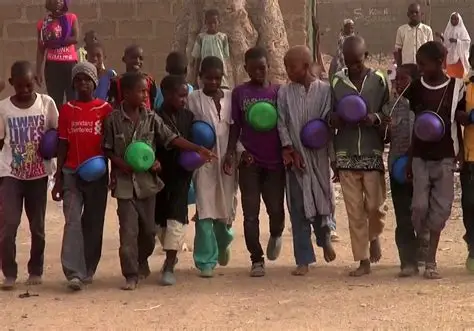
Today on Creative Despatch, I want to talk about two films that I watched because they carry the same title and deal with a subject that has been part of Nigeria's social and educational conversation for a very long time. The first is Toka McBaror's Almajiri, released in 2022 and subsequently released in Nigerian cinemas in 2023. The second is Jammal Ibrahim's "The Almajiri", released in 2026.
I decided to watch the two films together because I wanted to understand how two filmmakers could take the same subject and arrive at two different stories.
What I found interesting was not simply the difference in their stories. It was the difference in the way they make us look at the Almajiri child.
In McBaror's "Almajiri", the first thing that stayed with me was the vulnerability of the children. The film takes us into a world where children are separated from their parents, exposed to violence, forced begging, trafficking and other forms of exploitation. Salihu's experience becomes the centre through which we encounter this world.
The film does not spend much time introducing the Almajiri system to us as an educational or religious institution. It takes us directly into the consequences of what happens when children become vulnerable within that system.
That decision makes the film immediately emotional. We see the child being beaten. We see fear. We see adults exercising power over children. We see how poverty and trust can be used to take advantage of families.
I found myself thinking about the many Almajiri children Nigerians see every day without necessarily thinking about the circumstances behind the image. We see them on the streets, at traffic junctions and in markets. After some time, the image becomes ordinary. The child becomes part of the background.
The film tries to remove that familiarity. It asks us to look again.
But after watching the film, I had another question. Are we looking at the Almajiri system, or are we looking at one of its most disturbing manifestations?
That question matters because the Almajiri tradition is much older and more complex than the problems presented in the film. The system has its roots in Qur'anic education and the pursuit of Islamic knowledge in Northern Nigeria. There are serious problems associated with the welfare and education of many children within the system today, and research has documented issues around poverty, health, child labour, exploitation and inadequate living conditions. But those problems do not represent everything that the Almajiri tradition means.
This is where I became uncomfortable with some aspects of McBaror's film.
The film wants us to see the suffering, and that is important. But when suffering becomes almost the entire representation of a social group, another problem can emerge. The audience may begin to associate the Almajiri almost entirely with begging, poverty, violence, criminality and victimhood.
Some Northern Nigerian commentators have raised exactly this concern about the film. They argue that it risks reproducing an image of Northern Nigeria that reduces the Almajiri to the most negative aspects of the experience.
I do not think that criticism should be dismissed simply because the film is addressing a genuine problem. In fact, this is one of the things that makes the film worth discussing.
The problem is real. The question is how we represent it.
Then I watched Jammal Ibrahim's The Almajiri, and I noticed that I was looking at the same subject differently.
Rabiu is also an Almajiri child, but his poverty is not the most important thing the film wants us to see. The film makes his intelligence and his ambition central to the story. He wants to become a technology engineer. He wants access to another kind of education.
That changed my relationship with the character.
With Salihu, I was mostly concerned about what had happened to the child and how he could survive the circumstances around him. With Rabiu, I found myself thinking about what could happen to the child if he was given an opportunity.
That difference is very important.
The first film is largely concerned with the experience of exploitation. The second is more interested in the possibility that exists within the child.
I think this is one of the strongest things about "Almajiri",. It does not ask us only to feel sorry for the child. It asks us to recognise his ability.
Rabiu has an ambition.
He has an intellectual curiosity.
He wants something beyond the circumstances in which he has found himself.
That is a different way of representing an Almajiri child.
But I also do not think "Almajiri", solves everything.
The film is more ambitious in the questions it raises about education, religion, poverty and opportunity, but it also carries a lot of material. At more than two hours, there are moments when I felt that the story was trying to deal with more issues than it could properly develop.
There are questions about education. There are questions about religion. There are questions about politics. There are questions about poverty and the manipulation of vulnerable children.
Some of these ideas are strong, but they do not always come together with the same strength.
This is something I think we should be honest about when we discuss Nigerian cinema. A film can deal with an important subject and still have problems with its storytelling. The importance of the subject should not prevent us from examining the film itself.
That is also why I found the relationship between Rabiu and Mallam Bala interesting.
Mallam Bala is not presented simply as a wicked man who wants to destroy the child. He believes in the education he is providing. He believes that he is doing what is right. Rabiu, however, wants another form of education.
This creates a much more interesting conflict.
It is not simply Islam against Western education.
It is a disagreement about what education should give a child and what kind of future that child should have.
I think Nigerian cinema needs more of this kind of conversation.
We sometimes make the mistake of presenting Islamic education and formal education as if they must always be in opposition. But there is nothing inherently contradictory about a child being committed to his religion and also wanting to study science or technology.
Rabiu does not need to stop being who he is in order to become an engineer.
That is one of the questions the film leaves us with.
And then there is the question of language.
Both films benefit from the use of Hausa because the language gives the characters a sense of cultural location. But language alone does not make a film culturally authentic.
A filmmaker can use the right language, the right clothing and the right locations and still present a community through assumptions that come from outside that community.
This is why the criticism of McBaror's "Almajiri", is worth taking seriously.
If a film is made about a community, especially a community that is already heavily stereotyped, the filmmaker has to think about what images are being reinforced.
When we repeatedly see the Almajiri as a child begging on the street, we may forget that he is also a student.
When we see him only as a victim, we may forget that he has agency.
When we see him only as a product of poverty, we may forget the intellectual and religious traditions from which the system emerged.
This is where I think the two films actually complement each other.
McBaror's film reminds us that there are children experiencing real exploitation and that society cannot look away from that.
Ibrahim's film reminds us that the child cannot be reduced to the exploitation.
Both things need to be seen.
And perhaps this is what I find most interesting about putting the films beside each other.
They are not really arguing about the same thing.
McBaror is asking us to look at what happens when a vulnerable child is trapped within a system that can be exploited by adults.
Ibrahim is asking us to think about what happens when that same child has ability and ambition but does not have access to the opportunities available to other children.
One story is largely about survival.
The other is about possibility.
But there is something else that both films reveal about Nigerian cinema.
We have become very interested in making films about social problems. We make films about poverty, terrorism, corruption, child abuse, religious conflict and political violence. That is not a bad thing. In fact, I think Nigerian cinema needs to do much more of it.
But telling a story about a social problem is not the same thing as understanding the problem.
Sometimes we identify a villain and make the villain responsible for everything.
Sometimes we show the suffering and assume that showing the suffering is enough.
Sometimes we take a complex social reality and reduce it to a two-hour story with a beginning, a conflict and a resolution.
But these problems are much bigger than the films we make about them.
The Almajiri question did not begin with either of these films, and it will not end with them.
That is why I am more interested in what the films reveal than in simply deciding which one is better.
McBaror's film tells us that exploitation exists and that vulnerable children can be trapped in it.
Ibrahim's film tells us that the same children cannot be understood only through their vulnerability.
Both films are therefore making a contribution to the conversation, but they are also making choices about what they leave out.
And that is where I come to the question that interests me most as a filmmaker and film scholar.
When we put a camera in front of a social problem, what exactly are we recording?
Are we recording the problem itself?
Are we recording the way the filmmaker understands the problem?
Are we recording the way society sees the people affected by it?
Or are we doing all three at the same time?
I think we are.
That is why I do not see these films simply as entertainment.
They are also records of how Nigerian filmmakers are trying to understand a part of Nigerian society.
Years from now, somebody may watch these films and use them to understand how the Almajiri was represented in Nigerian cinema in the 2020s. They will not be able to take everything on the screen as historical fact. They will have to ask why the filmmaker chose these characters, these images, these conflicts and these endings.
That, for me, is where cinema becomes interesting as an archive.
The film does not have to tell the whole truth for it to become evidence of how a society understood itself.
And when I put "Almajiri", and The Almajiri beside each other, what I see is not simply two films about children in Northern Nigeria.
I see two filmmakers asking us to look at the same child in two different ways.
One asks us to see what the child has suffered.
The other asks us to see what the child could become.
For me, Nigerian cinema needs both.
But we also need to keep asking whether we are giving people the opportunity to tell their own stories, or whether we are simply deciding what their stories should look like from behind the camera.
That is the conversation I think these two films have opened.